Module 3
The AI-ER Framework
The four regulatory elements in depth, and why they work as a system rather than a checklist.
Learning Objectives
- Define each of the four regulatory elements precisely and recognize it in practice.
- Explain the reciprocal relationships among the elements and why emphasizing one in isolation creates a failure mode.
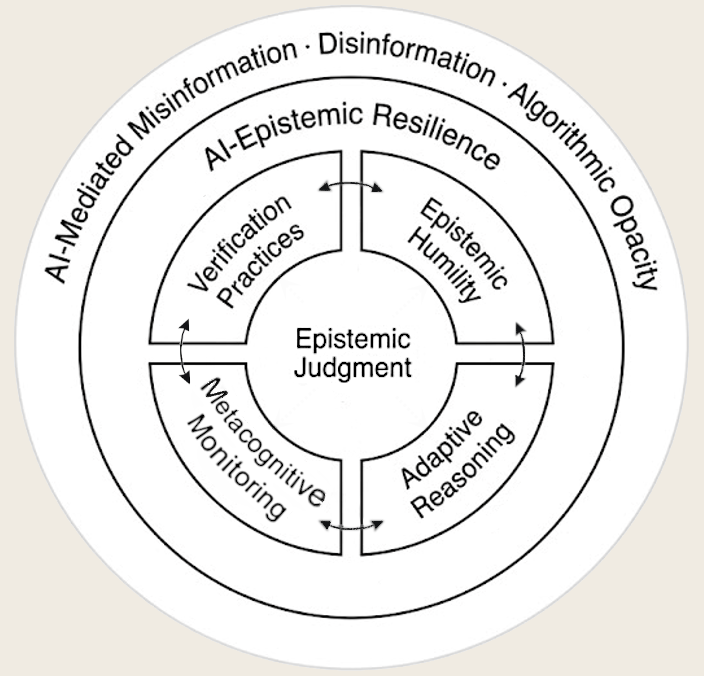
- Read the framework diagram as a map of a dynamic epistemic stance rather than a fixed sequence.
From four parts to one stance
Module 1 introduced the four regulatory elements. This module develops each one and, more importantly, shows how they hold together. The central claim is easy to state and easy to forget: these are not four steps you perform in order, and not a checklist you tick off once per task. They form a dynamic system. Each one shapes and is shaped by the others, continuously, as you work. The diagram below is the map to return to as you read.
Verification Practices
Verification is the habit of checking and corroborating information against reliable sources before relying on it. With AI, this means treating an output as a claim to be confirmed rather than an answer to be accepted. A statistic gets traced to its origin. A cited study gets located and read, or found not to exist. A factual assertion gets checked against a source you trust independently of the model.
The skill is not to verify everything, which is impossible, but to verify in proportion to the stakes. A low-stakes summary you can see for yourself needs little. A figure you are about to put in a report, a clinical claim, a legal point, these earn real checking. Verification is where the gap between fluency and fidelity gets tested directly.
Epistemic Humility
Humility is an openness to being wrong and a recognition of the limits of both your own knowledge and the AI's. It is the element that keeps you from hardening into certainty in either direction, neither assuming the AI must be right because it sounds authoritative, nor assuming you must be right because you are the human.
In practice, humility shows up as a question you keep available: what if this is wrong, and how would I know? It is what makes you willing to check in the first place, and willing to revise when a check comes back against your expectation. Without it, verification has no motive to begin.
Adaptive Reasoning
Adaptive reasoning is the ability to adjust your thinking when circumstances change or when outputs conflict with what you know. It is the opposite of defending a first answer past the point the evidence supports it. When an AI output contradicts expert knowledge, or when two sources disagree, adaptive reasoning is what lets you change course rather than rationalize.
Note what it is not. Adaptation is not changing your view at every push, which is just instability. It is changing your view when there is reason to, and holding it when there is not. The judgment of which is which is the skill.
Metacognitive Monitoring
Metacognitive monitoring is reflective awareness of your own thinking, including how your interaction with AI is shaping your judgments and your confidence. It is the element that watches the other three. Are you checking less because the output sounds polished? Has your confidence risen for any reason other than evidence? Are you starting to defer to the model out of habit?
This is the element most easily skipped, because it requires attention turned inward while you are busy with a task. But it is what keeps the whole system honest. Without it, the other elements run on autopilot and slowly drift.
Why they form a system
The elements are valuable individually, but their real strength is in how they feed one another. Verification can reveal a gap in your understanding, which prompts humility. Humility, in turn, motivates further verification by keeping you open to conflicting evidence. Adaptive reasoning depends on monitoring to notice that an adjustment is needed, and monitoring depends on humility to take the noticing seriously. The arrows in the diagram run both ways for this reason. The system has no fixed starting point and no end.
This is why AI-ER is best understood as a dynamic epistemic stance: always balancing trust and doubt, always learning and adjusting, always aware of your own thinking.
What happens when one element is missing
The clearest way to see that these work as a system is to watch what happens when one is emphasized in isolation. Each element, alone, fails in a characteristic way.
Each failure is the predictable result of one element running without its counterweights. Held together, they correct one another. That mutual correction is the framework.
Tracing the Loop
Recall a recent AI interaction that went well, one where you ended up with something you could trust. Trace the loop through it.
- Where did you verify, and what made you decide that point was worth checking? (Verification)
- What kept you open to the output being wrong, or to your own assumption being wrong? (Humility)
- Was there a moment you adjusted course? What triggered it? (Adaptive Reasoning)
- Were you aware, in the moment, of how the AI was shaping your thinking, or only afterward? (Metacognitive Monitoring)
Now identify which element was weakest in that interaction. That is the one most worth strengthening, because in a system the weakest element sets the ceiling for the rest.
Knowledge Check
- The four regulatory elements are best understood as:
a) A sequence completed in order
b) A checklist finished once per task
c) An interdependent system whose elements continuously shape one another
d) Four independent skills best practiced separately - Verification practiced without epistemic humility tends to produce:
a) Passive acceptance of AI output
b) Rigid skepticism that dismisses well-supported evidence
c) Aimless changes in approach
d) Better calibration automatically - The element that watches the other three and notices when your confidence has risen without reason is:
a) Verification Practices
b) Epistemic Humility
c) Adaptive Reasoning
d) Metacognitive Monitoring - Adaptive reasoning is best described as:
a) Changing your view at every challenge
b) Never changing your view once formed
c) Adjusting when there is reason to, and holding when there is not
d) Deferring to the AI when sources conflict - True or False: A good rule is to verify every AI output equally and completely.
(False. Verify in proportion to the stakes; equal effort everywhere is neither possible nor useful.) - Monitoring without adaptation leaves a thinker:
a) Unable to notice problems
b) Able to describe a problem clearly while staying stuck on the same path
c) Perfectly calibrated
d) Overly skeptical of all sources
Answer key: 1-c, 2-b, 3-d, 4-c, 5-False, 6-b.
What is next
With the framework in place, the next three modules put it to work. Module 4 applies AI-ER in education, Module 5 in industry, and Module 6 in civic life.
References
Finley, R. V. (2026). AI-Epistemic Resilience: A Framework for Knowledge Integrity in the Age of Artificial Intelligence. Self-published.